
A clinic owner once told me — almost word for word — “I don’t mind spending money if we’re getting results. But I’ve spent probably $40,000 already and I haven’t really had any results.”
Two years. Forty thousand dollars. And he still couldn’t rank on page one of Google.
The thing is, this isn’t a story about a bad agency or an unlucky campaign. It’s about a much more common problem — one that’s quietly draining marketing budgets across allied health practices in Australia every single month.
And it starts with a question that almost no one asks before they spend their first dollar.
The vanity metric trap
When this clinic owner came to me, his goal was crystal clear: rank number one on Google for “psychologist Gold Coast.”
That was it. That was the whole strategy. Rank number one, get more clients. Simple.
Except it’s not that simple — and that keyword doesn’t really work the way he thought it did.
Google’s search results are personalised. What you see when you search “psychologist Gold Coast” depends on where you’re sitting right now, your search history, the time of day, and dozens of other signals Google uses to decide what’s most relevant to you. There’s no single “number one” position. It shifts constantly, and it shifts for everyone differently.
More importantly — ranking number one for a broad, competitive keyword isn’t a business objective. It’s what we’d call a vanity metric. It’s a number that feels meaningful but doesn’t tie to anything that actually moves the needle for a clinic: phone calls, booked appointments, revenue.
Amplified Marketing works with allied health practices Australia-wide, and this kind of goal confusion is one of the most common things we see. Practices invest heavily in SEO without first defining what success actually looks like in measurable terms. Before a single dollar gets spent on marketing, a clinic needs to know what outcome they’re working toward — not “rank number one,” but something like “increase new patient enquiries by 20% over the next 90 days.” That’s a goal you can track. That’s a goal you can optimise toward. For a practical guide on doing this well, we’ve written about setting SMART goals for allied health practices.
Generic marketing for a specialist industry
The second problem wasn’t just the goal — it was the execution.
When we dug into what this clinic’s marketing was actually doing, the picture became clearer. A generalist agency. One blog post a month. Google Ads running in the background. And nobody in the room who truly understood allied health.
There was no targeting around an ideal client. No thought given to the questions people actually type into Google when they’re in distress, looking for support for themselves or their children. No AHPRA-compliant messaging designed to speak to those people with empathy and clarity. No understanding of the compliance nuances that set allied health marketing apart from every other industry.
This matters enormously. When someone searches for a psychologist, they’re not shopping for a product. They’re often scared, overwhelmed, and already vulnerable. The marketing that reaches them needs to reflect that. It needs to feel like the practice understands them — their specific concerns, their circumstances, what outcome they’re hoping for. Knowing your ideal client deeply is the foundation that makes every other piece of the marketing work.
Instead, this clinic was running campaigns that spoke to everyone in general and no one in particular. The website had no clear conversion path. The contact form had been broken at some point and no one noticed because no one was tracking it. And the ads were generating conversions — phone calls — but the clinic couldn’t say with any certainty how many new clients those calls were producing, or at what cost.
“We think it’s working, but we can’t really show you” is not a reporting strategy. It’s a warning sign.
Why clinics keep paying for something that isn’t working
So how does a practice spend $40,000 over two years without pulling the pin?
It comes back to visibility — or the lack of it. If you don’t have the data to show that something isn’t working, you’ll default to the assumption that it is. And when you’re also scared that stopping will cause enquiries to dry up, you stay stuck. You keep paying, keep hoping, and keep telling yourself it’s building toward something.
The reality is that this clinic’s marketing was probably doing something. It wasn’t a total waste. But it could have been doing significantly more, for less money, with the right strategy behind it.
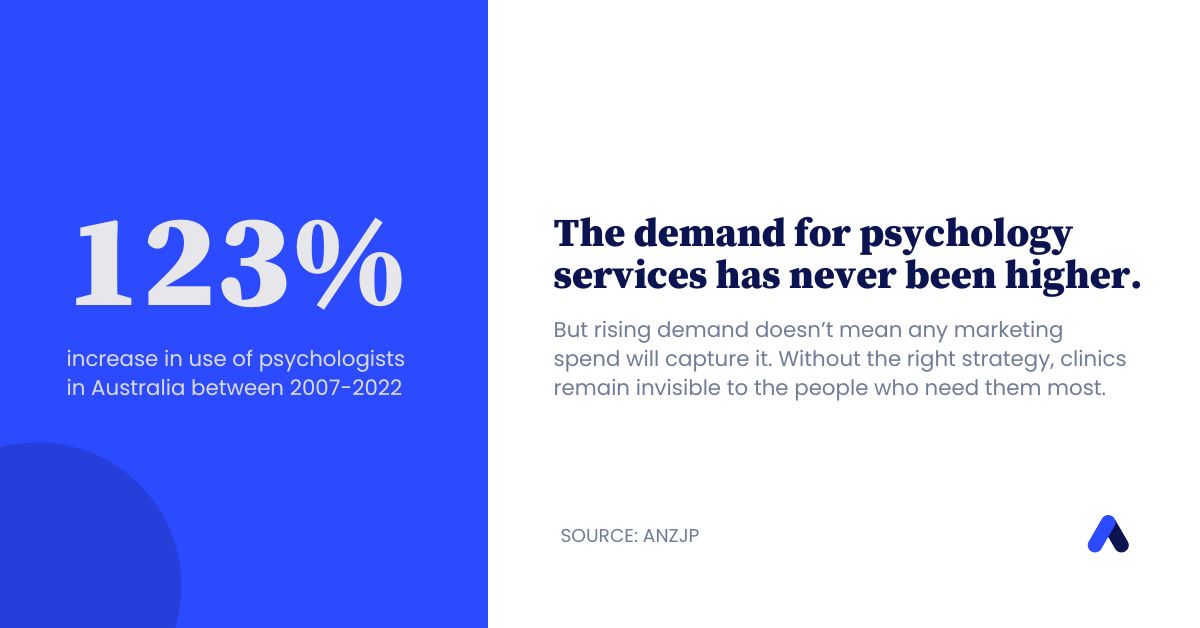
This situation is more common than most practice owners realise. Australia’s demand for psychology services has grown dramatically — research published in the Australian & New Zealand Journal of Psychiatry found that use of psychologists increased by 123% between 2007 and 2020–22.
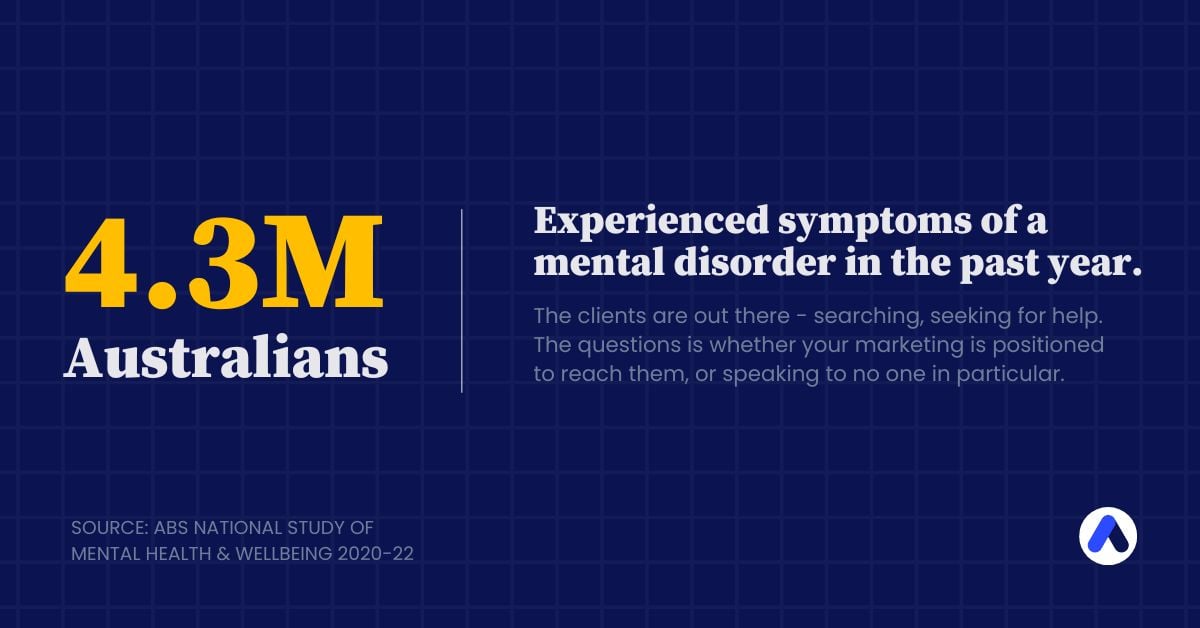
More than 4.3 million Australians experienced symptoms of a mental disorder in the twelve months to 2022. And according to the Australian Institute of Health and Welfare, over $1.5 billion in Medicare-subsidised mental health services were delivered in 2023–24, with psychologists accounting for the largest share. The demand is real and growing — but that doesn’t mean any marketing spend will capture it.
The questions you should be asking your agency right now
If any of this is landing a bit close to home, here’s where to start. Get on a call with your agency — which should be happening monthly at minimum — and ask these questions directly.
Can you show me our conversion numbers this month, broken down by type? That means phone calls, contact form submissions, and emails — and ideally, which channel each came from. If they can’t show you this, you’re flying blind.
How are you measuring lead quality? Traffic and clicks don’t pay wages. You need to know whether the people getting in touch are the right kind of clients — and that requires a feedback loop between your marketing activity and your front desk.
What are you doing each month to grow our visibility? Not in vague terms. Specifically — what activities are building your authority in the local market this month?
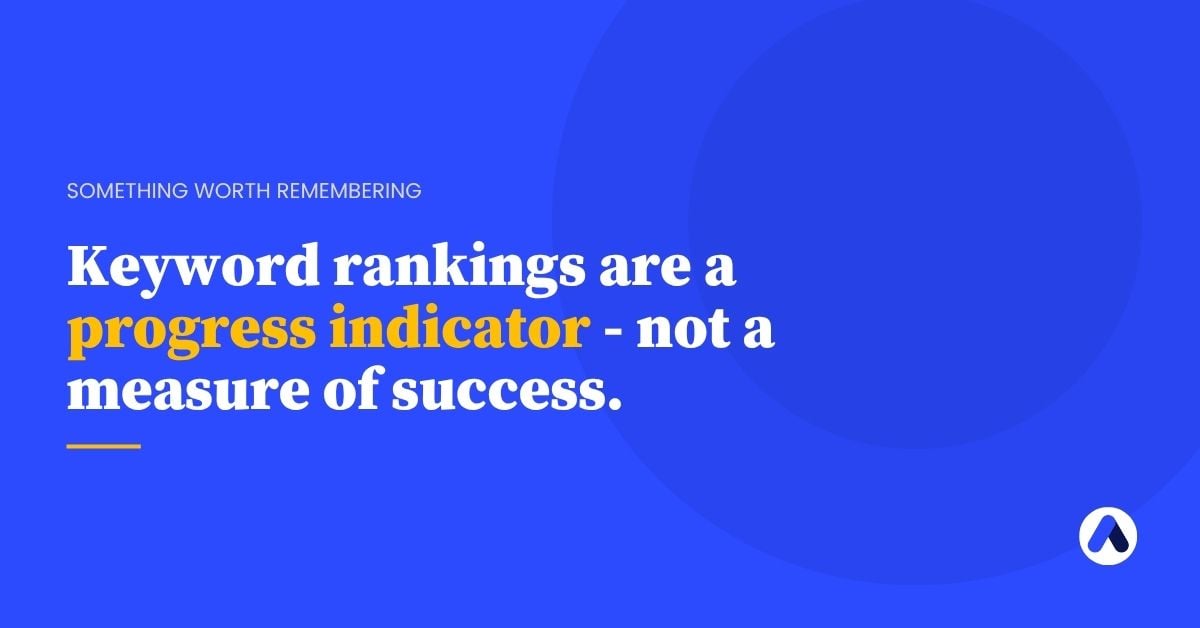
Can you show me keyword ranking movement over the last three to six months? Actual data, not anecdotes. To be clear — keyword rankings are a secondary metric. They show that the SEO work is moving in the right direction, but they don’t tell you whether more of the right people are actually getting in touch. Treat them as a progress indicator, not a measure of success in themselves.
Are you optimising for AI search engines, not just Google? This one is newer, but it matters. When someone asks ChatGPT, Claude, or Google’s AI overview to recommend a psychologist in their suburb, is your clinic showing up? This is called generative engine optimisation — and it should now form part of any serious SEO strategy. If your agency hasn’t mentioned it, ask why.
What’s our website conversion rate, and what are you doing to improve it? Getting traffic to your site is only half the job. If the site isn’t converting visitors into enquiries, the rest of the spend is wasted.
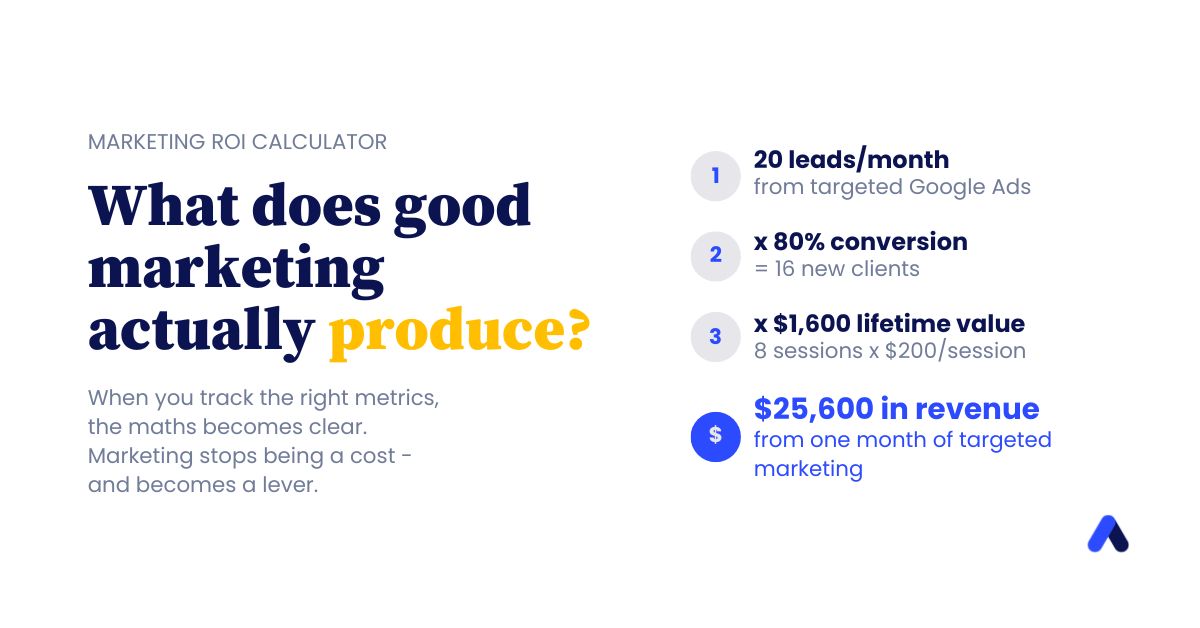
Once you have this data, you can start doing the maths that actually matters. If your Google Ads generated 20 leads in a month, and around 80% of those become clients, that’s 16 new clients. If the average patient attends eight sessions at $200 per session, each new client is worth roughly $1,600 to the clinic. That’s about $25,600 in revenue from a single month — from a campaign that might cost $2,000–$4,000 all in. Suddenly, marketing isn’t a cost. It’s a lever.
What the first 90 days should actually look like
If this clinic had come to us from day one, the approach would have been completely different.
Before a single ad went live or a single article was written, we’d run an ideal client profile workshop — what we call a Perfect Patient Profile session. This is the work that sets the foundation for everything else. Who does the clinic actually want more of? What are those people searching for? What language do they use? What does life look like for them before they pick up the phone?
For a psychology clinic, that might be parents who’ve spent months trying to get an assessment for their child. Or someone finally ready to address anxiety that’s been holding them back for years. The marketing needs to meet them where they are — with empathy, not a brochure.
From there, every channel — Google Ads, local SEO, website copy, content marketing — gets built around answering the real questions that ideal client is asking. Not “best psychologist Gold Coast,” but “what happens in a psychological assessment for my child?” or “how do I know if I need to see a psychologist?” That’s where the high-intent, lower-competition traffic lives. That’s where you can rank faster and attract better-fit clients.
Conversion tracking gets set up before day one. Not retrofitted three months in. And the website gets treated as a conversion tool, not a brochure — because no amount of traffic matters if the booking page is buried behind three intake forms and an FAQ accordion.
You can see what this approach looks like in practice in our client case studies.
The honest advice if you’re on the fence
If you’re currently working with a marketing provider and you’re not sure whether it’s working, the answer isn’t to panic and cancel everything. It’s to ask the hard questions.
Get clear on your numbers. Understand what’s working and what isn’t. Ask whether the people running your campaigns actually understand AHPRA advertising guidelines, the nuances of how people search for mental health support, and the ethical considerations that come with marketing in this space. A generic agency might be technically competent and still completely wrong for your practice.
If you can’t get straight answers — or if the answers reveal that results have been thin and visibility has been limited — it might be time to get a second opinion.
That’s exactly what our free Growth Diagnosis Call is for. No pitch, no pressure. Just an honest look at what’s working, what isn’t, and what a specialist allied health marketing strategy could do differently.
Because every allied health clinic in Australia deserves marketing that actually understands them — and results they can see.