

There’s a big shift happening in how people find local health services online. And if you’re an allied health clinic owner – it’s worth paying attention to.
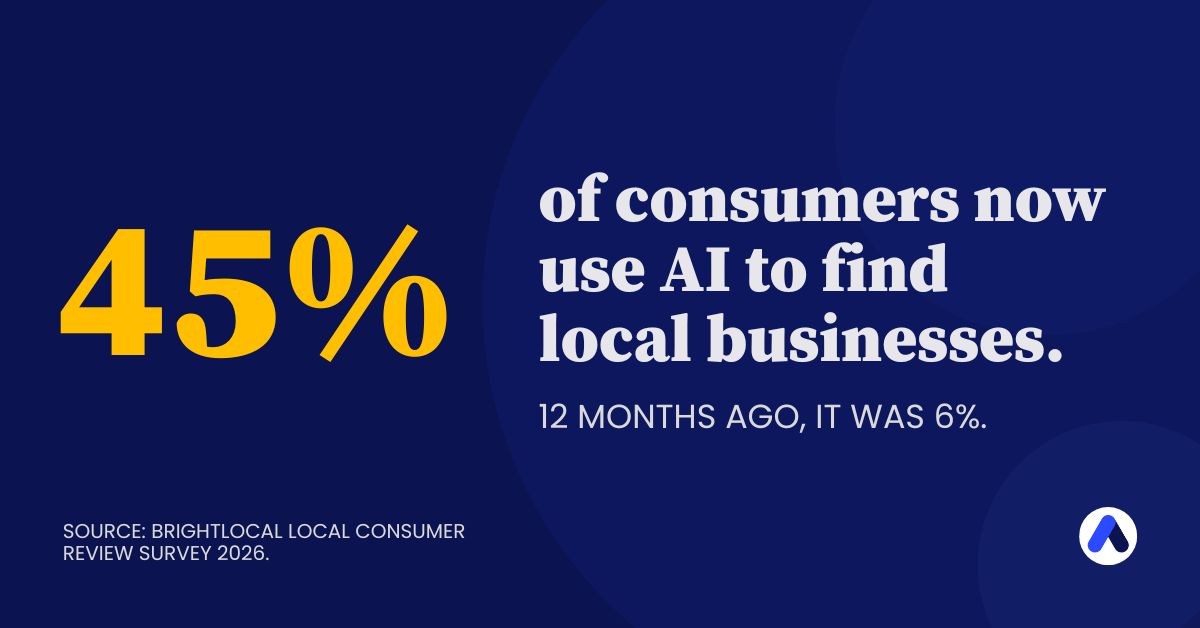
According to BrightLocal’s 2026 Local Consumer Review Survey, 45% of consumers now use AI tools like ChatGPT, Gemini, or Perplexity to find local business recommendations (including health services). Twelve months ago, that number was 6%. That’s not growth. That’s a complete behavioural reset in a single year.
Almost half your potential clients are no longer opening Google and scanning results. They’re opening ChatGPT, typing something like “best psychologist in Brisbane for anxiety” or “speech pathologist near me for kids”, and getting back a short list of names.
The question is: is your clinic on that list?
For most practices, the honest answer is no. And this article will outline why that matters more than you might think.
Note: The research cited throughout this article is primarily drawn from US-based studies. While Australian-specific data at this scale doesn’t yet exist, consumer behaviour in Australia is tracking a similar trajectory, and the underlying mechanics of how AI tools surface local businesses are identical regardless of geography.
The selectivity problem: AI is not Google
Here’s the data point that should get your attention.
SOCi’s 2026 Local Visibility Index analysed more than 350,000 business locations across 2,751 multi-location brands and found that ChatGPT recommends just 1.2% of local businesses when asked for a recommendation. Google’s local 3-pack, by comparison, surfaces businesses 35.9% of the time.
That makes AI local visibility up to 30 times harder to achieve than ranking in traditional local search.
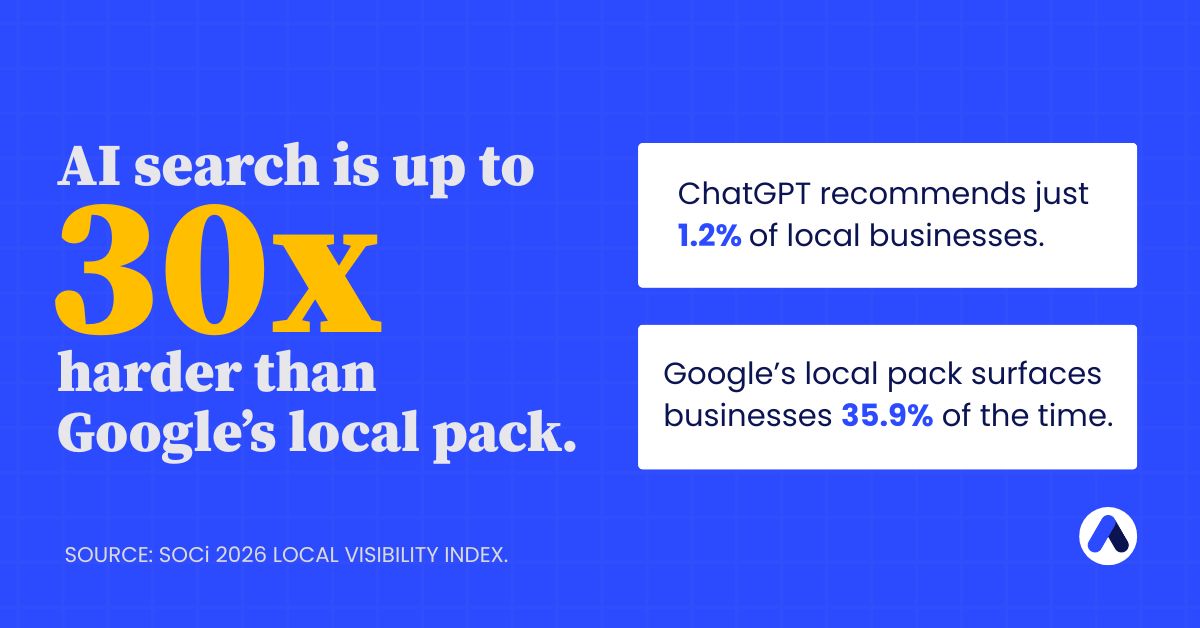
Let that sink in. The Google local pack is already competitive. AI search is thirty times harder to crack.
The reason isn’t arbitrary. It comes down to how these systems work. Google ranks pages based on proximity, category, and a range of technical signals. AI assistants don’t rank. They recommend. And they only recommend businesses they have high confidence in. That confidence is built from data accuracy, review quality, and consistent signals across multiple platforms.
If any part of your digital presence is patchy, inconsistent, or incomplete, the AI’s confidence in recommending you drops and it moves on.
The gap between Google rankings and AI visibility
Here’s what makes this particularly confronting for clinics who’ve invested in local SEO: strong Google performance doesn’t automatically carry over.
SOCi’s research found that in the retail sector (with similar patterns seen across other categories), only 45% of brands that led in traditional local search also appeared in AI recommendations. More than half of the businesses winning in Google Maps were completely absent from AI-generated results.
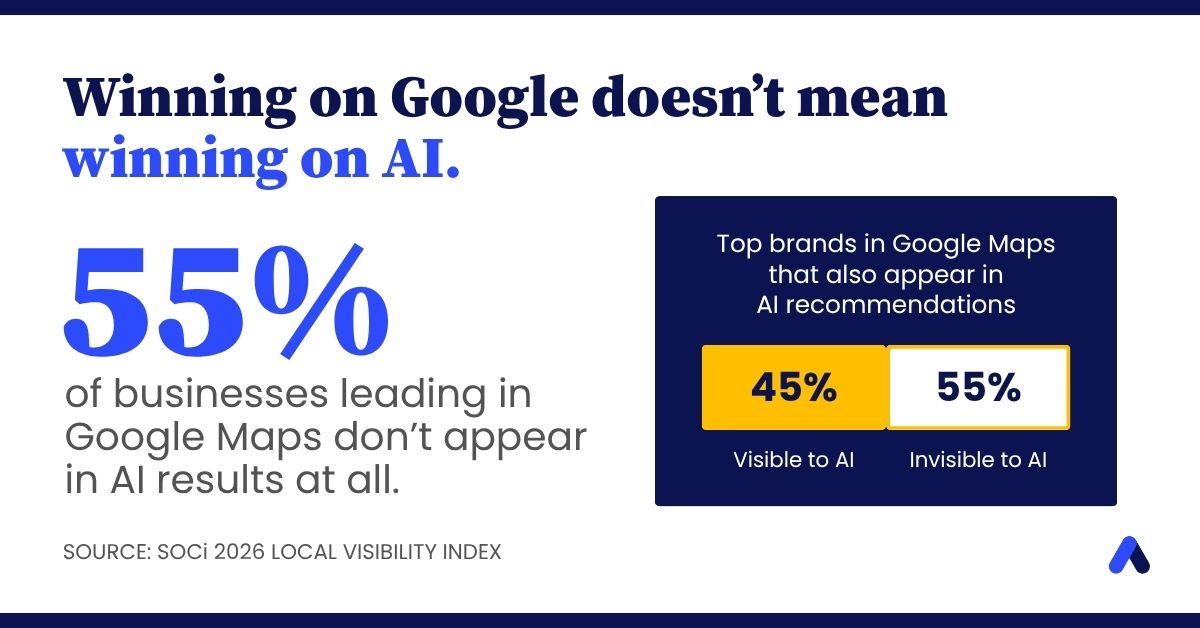
The same dynamic applies to health services. Your practice might have solid Google Maps rankings, a well-maintained Google Business Profile, and consistent bookings from search. None of that guarantees ChatGPT or Perplexity knows you exist, or trusts you enough to recommend you.
The shift is structural, not superficial. AI assistants pull information from across the web (your GBP, Yelp, health directories, third-party mentions, and review platforms) and synthesise it into a picture of your business. If that picture is incomplete, outdated, or inconsistent, you’re out.
What AI actually looks for (and what most clinics are missing)
So what makes an AI assistant confident enough to recommend a health practice? The research points to a handful of clear factors.
1. A complete, accurate Google Business Profile
Gemini, Google’s AI assistant, draws directly from Google Maps data, which means GBP accuracy has a direct line into AI recommendations. But it matters beyond just Gemini. SOCi found that business profile information was only about 68% accurate on ChatGPT and Perplexity, meaning almost a third of businesses have wrong, incomplete, or mismatched details showing up in AI systems.
For your clinic, this means your GBP needs to be fully built out: hours, services, locations, descriptions, photos, and categories. Not set-and-forget. Actively maintained.
2. Consistent NAP data across all directories
NAP stands for Name, Address, Phone. If those three pieces of information are inconsistent across platforms (your GBP, Yelp, Healthengine, HotDoc, Australian Business Register, NPS website, or wherever your practice appears), AI systems flag the inconsistency and lose confidence.
ChatGPT cross-references your information across sources. A different phone number on one directory, a slightly different business name on another, an old address that was never updated. Each of these chips away at the AI’s willingness to put your name in front of someone looking for your services.
3. Review volume, recency, and rating
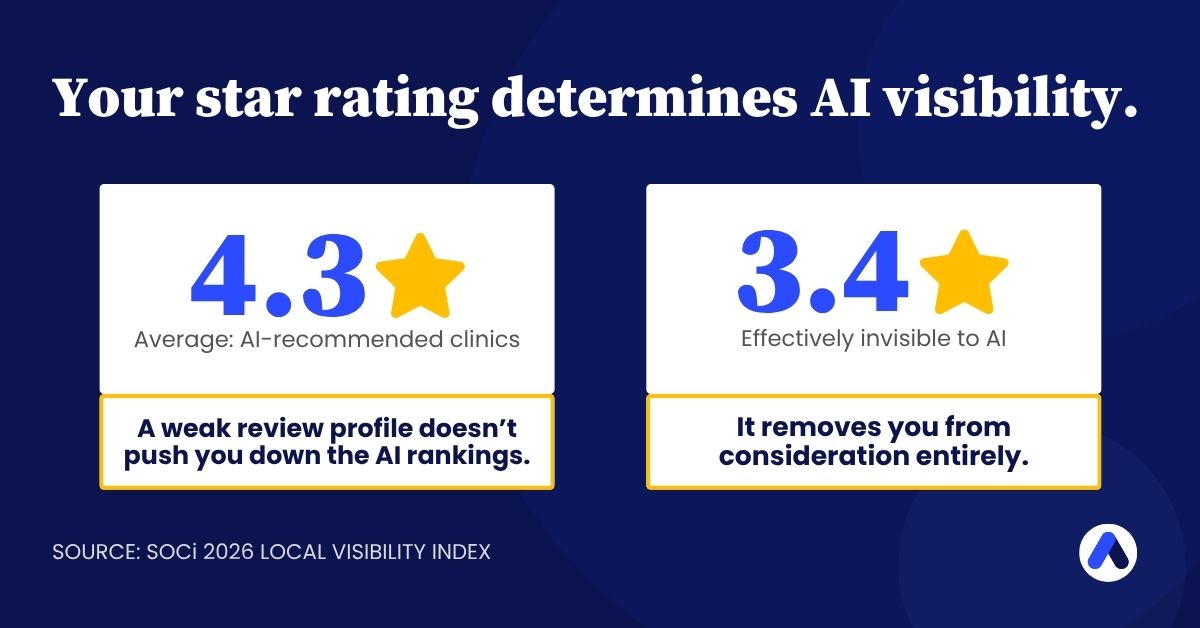
The data here is stark. Businesses recommended by ChatGPT averaged 4.3 stars. By comparison, businesses with average ratings around 3.4 stars and low review response rates were described by SOCi as “effectively invisible” in AI recommendations.
This matters enormously for allied health practices, where AHPRA compliance constraints mean you can’t solicit testimonials or use patient reviews in advertising in certain ways. But there’s nothing preventing you from having a strong, genuine review profile on Google and actively asking satisfied clients to leave one.
BrightLocal’s 2026 survey found that 97% of consumers read reviews before choosing a business, and 88% of those who receive an AI recommendation go and fact-check it against reviews before booking. So even if AI recommends you, a thin review profile will cost you the conversion.
Reviews are the bridge between being recommended and being chosen.
4. Third-party mentions and citations
AI systems treat mentions of your business across the web as evidence that you’re legitimate and trusted. This goes beyond directory listings. Editorial mentions, local news coverage, health resource roundups, and allied health directories all count.
Being featured in a “top psychologists in [suburb]” article, mentioned in a local parenting blog, or listed in a relevant professional directory all contribute to the web of signals that makes AI systems more willing to recommend you.
This is where a content and link-building strategy earns its keep in a way that goes beyond traditional SEO.
Why this is urgent for allied health practices
The consumer behaviour shift is happening now. BrightLocal’s data shows AI usage for local business discovery went from 6% to 45% in a single year. Among 30 to 44 year olds, a core demographic for psychology, speech pathology, OT, and physiotherapy, adoption is sitting at 64%.
Here’s the uncomfortable reality: you can’t see what you’re missing.
There’s no analytics alert when ChatGPT doesn’t recommend your clinic. No ranking drop notification. A potential client types their query, gets three or four names, and books with one of them. You never knew you were being considered. You have no data showing the loss.
The only way to know where you stand is to test it yourself. Open ChatGPT, Perplexity, or Gemini and search for your own services in your suburb. See what comes back. If your clinic isn’t there, now you know what to work on.
The good news: the fix is the same
Here’s where the picture gets more optimistic.
The signals that help you rank in Google’s local pack are the same signals that help you show up in AI recommendations. You’re not rebuilding from scratch. You’re reinforcing and completing the foundations that should already be there.
- Complete your GBP: every field, every category, regular updates.
- Audit your citations: find where your NAP data is inconsistent and fix it.
- Build your review profile: ask every satisfied client, and respond to every review.
- Get listed in relevant directories: Healthengine, HotDoc, Allied Health Professions Australia, and any other credible directories relevant to your modality.
- Create dedicated service and location pages on your website. AI assistants specifically favour practices with pages that clearly outline individual services in detail.
The businesses showing up in AI recommendations aren’t doing anything exotic. They’ve done the fundamentals properly, across every platform, consistently over time.
What this means for your clinic right now
The allied health sector is behind the curve on this. Most practices either haven’t heard of AI search visibility, or assume their Google rankings are enough. Neither assumption is going to serve them well as the year progresses.
The window to establish visibility before your competitors do isn’t infinite. Every month of inaction means competitors who are appearing in AI recommendations are accumulating reviews, mentions, and authority signals that become harder to displace.
If you’d like to understand where your clinic stands and what would need to change to show up where your potential clients are now looking, that’s a conversation worth having.
Sources:
BrightLocal Local Consumer Review Survey 2026
SOCi 2026 Local Visibility Index — Search Engine Land, January 2026
BrightLocal Local SEO Statistics 2026