Why Allied Health Clinics Hit a Growth Ceiling (And How to Break Through It)

There’s a moment most allied health practice owners know intimately.
The referrals are coming in. Word of mouth is ticking along. Revenue looks okay on paper. But something feels off. Growth has quietly stalled. The calendar isn’t as full as it should be. And somewhere between treating patients, managing staff, handling admin, and trying to keep the wheels turning, a creeping realisation sets in — if anything is going to change, something has to change.
This is the allied health growth ceiling. And in our experience working with psychology clinics, physiotherapy practices, occupational therapists and podiatrists across Australia, it’s almost universal.
The good news? It’s entirely breakable. But first you need to understand exactly why it happens.
What the Growth Ceiling Actually Looks Like
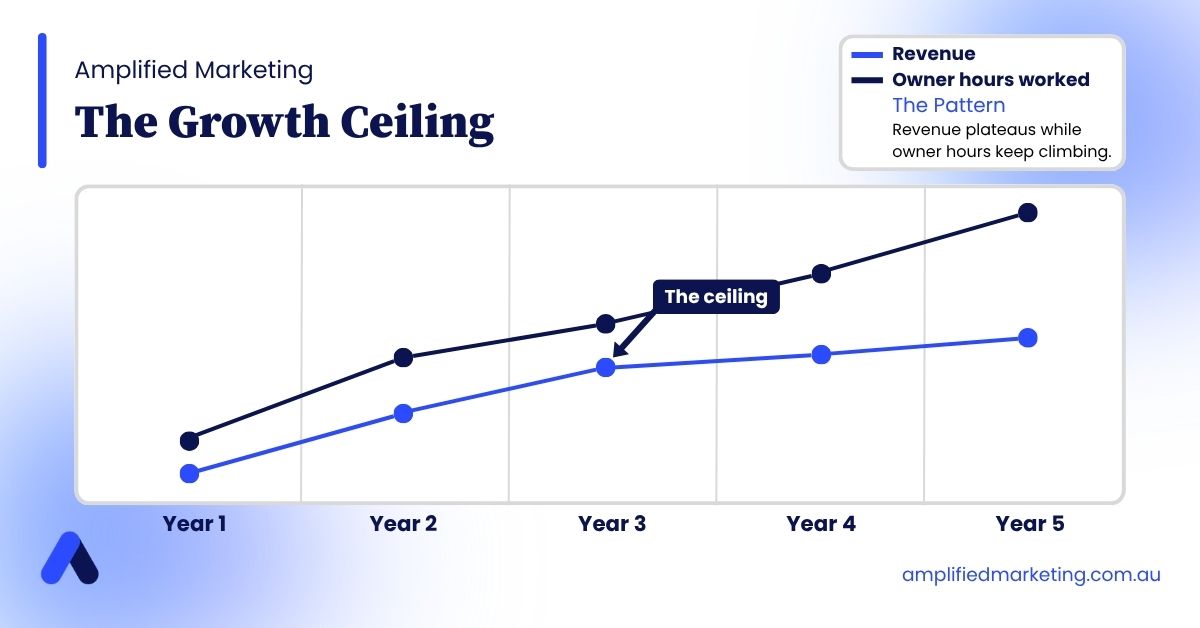
The 60-70 Hour Week Trap
Most practice owners that I speak to who hit the ceiling are working harder than anyone gives them credit for.
They’re working 60, sometimes 70 hours a week — seeing patients, managing a small team, chasing overdue invoices, and somewhere in the gaps, attempting something that loosely resembles marketing. A social media post here. A blog article there. Maybe a Google Ads campaign that ran for a couple of months without much to show for it.
The marketing is ad hoc, reactive, and inconsistent — not because the owner doesn’t care, but because there are simply not enough hours in the day to do it properly. Clinical responsibilities come first. Admin fills the gaps. Marketing gets whatever’s left — which is usually very little.
And so the business plateaus. Revenue sits at a number that feels uncomfortable — not bad enough to panic, but not growing the way it should be. New client enquiries are unpredictable. Some weeks are great. Others are quiet, and nobody quite knows why.
This is the ceiling in action.
The Fork in the Road
When practice owners reach this point, they typically face a genuine fork in the road.
The first path: step back from running the business and return to clinical work. For many practitioners, this is exactly the right choice. They got into the profession to help people — not to manage a CRM or figure out why their Google Ads aren’t converting. Stepping back into clinical hours is a legitimate decision, and one we respect. But it usually means the business stays where it is.
The second path: commit to building proper systems — marketing systems, operational systems, team systems — that allow the business to grow without the owner carrying every single part of it. This is the path that leads to full practitioner calendars, a business that doesn’t depend entirely on one person, and in many cases, a genuine exit opportunity down the track.
Which path is right depends entirely on what you want from your practice. But if you’ve chosen the second — or you’re seriously considering it — understanding why you’ve hit the ceiling is the essential first step.
Why GP Referrals and Word of Mouth Stop Working
Let’s be clear upfront: GP referrals are valuable. The leads are warm, conversion rates are high, and the clients tend to be a strong fit for your practice. Word of mouth is the same — when it works, it really works.
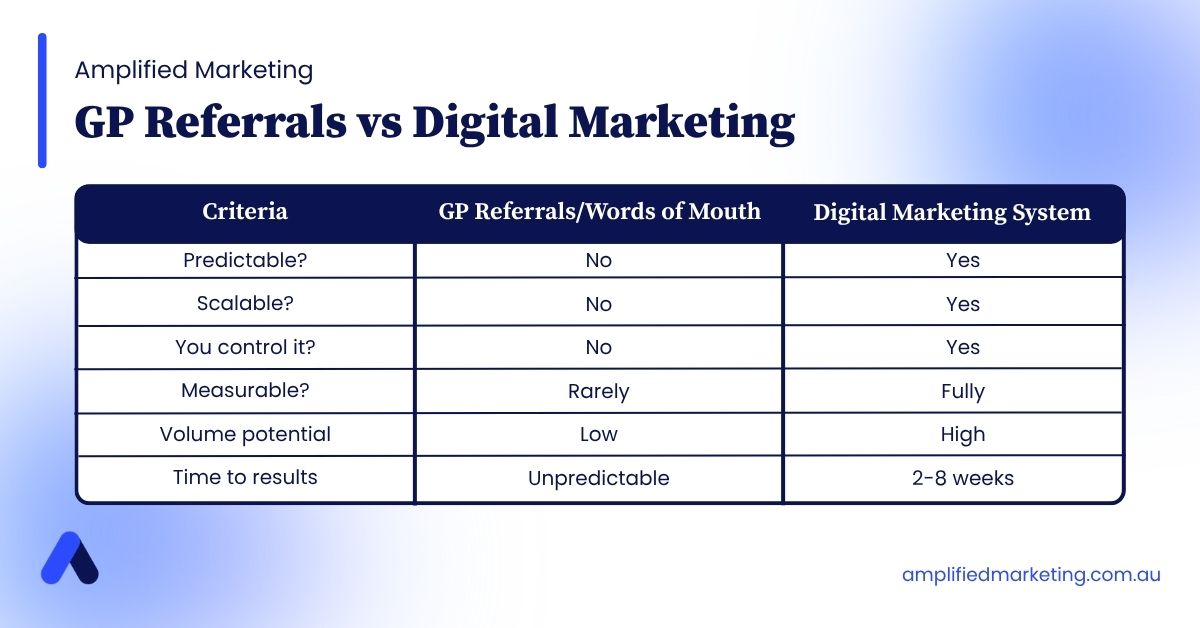
But here’s the fundamental problem with both. They are neither scalable nor predictable. And those two things, above everything else, are what you need to grow a business sustainably.
The Unpredictability Problem
When your new client pipeline depends on GP referrals, you’re at the discretion of a third party who has dozens of other practices they can send patients to. Some weeks the referrals flow through. Others, nothing. There’s no pattern, no rhythm, and no way to plan around it.
And it may be even more arbitrary than you think. Research published in InSight+ (Medical Journal of Australia) found that in Australian primary care, referrals to psychologists are frequently made on purely practical grounds — who has an appointment available, who is nearby, or who happens to be someone the GP knows. In other words, whether your practice gets that referral can come down to whether the GP had your number handy that day.
That’s not a growth strategy. That’s luck.
Word of mouth carries the same problem. You can’t control when a satisfied patient recommends you to a friend, or whether that friend actually books. It’s passive, entirely outside your influence, and impossible to plan around.
The Scalability Problem
Even in their best weeks, GP referrals will never generate high-volume, consistent lead flow. The pool of potential referrals is also smaller than most practice owners assume. According to the Grattan Institute’s Mapping Primary Care in Australia, only around 16% of GP consultations result in any referral at all — and of those, roughly 60% go to medical specialists, with the remainder split across all allied health services. That means you’re competing with every other allied health practice in your area for a relatively thin slice of GP attention.
And yet, the demand for allied health services — particularly mental health — is growing. Mental health concerns now account for over 12% of all GP appointments in Australia, a figure that’s been climbing steadily since 2007. The patients are out there. They’re just not all finding you through GP referrals — and many of them are searching Google right now instead.
Compare that to a well-structured Google Ads campaign, where you control the budget, the targeting, the timing, and the messaging. You can increase spend when you need more leads. You can pull back when the calendar is full. You have data, visibility, and control.
We explore the full comparison in our guide to SEO vs Google Ads for allied health, but the core point is this: proactive digital marketing gives you control over your lead flow. Referral-based growth does not.
What Proactive Marketing Looks Like by Comparison
With a proper digital marketing system in place, you know:
- How many people searched for your services this week in your local area
- How many visited your website and which pages they looked at
- How many submitted an enquiry and through which channel
- What each new client cost you to acquire
- Which campaigns are delivering and which need adjustment
This is measurable, manageable, and improvable. It’s the difference between hoping leads arrive and having a system that generates them. And for a practice trying to grow beyond the ceiling, that difference is everything.
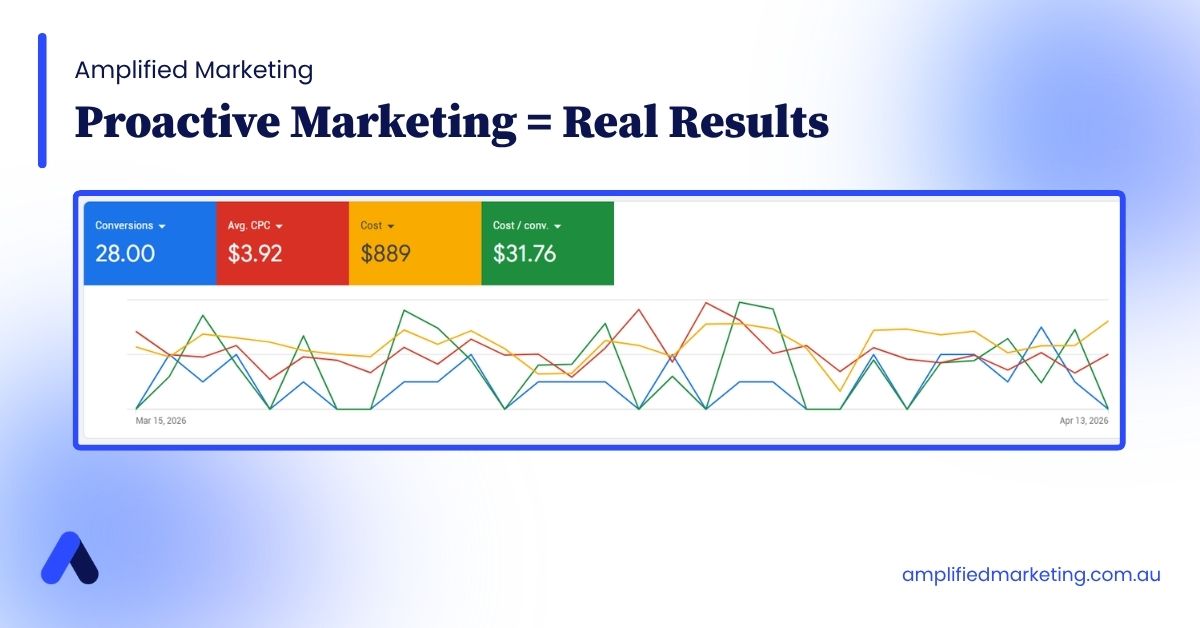
In this image below you can see one of our client campaigns acquiring 28 new patients for a clinic in a 30 day period with a very modest budget.
Building a System That Breaks Through the Ceiling
What a Real Marketing System Actually Looks Like
When we talk about a marketing system, we don’t mean a social media calendar or a monthly newsletter. We mean a structured, end-to-end process that reliably brings potential clients to your website, converts them into enquiries, and gives you the data to improve over time.
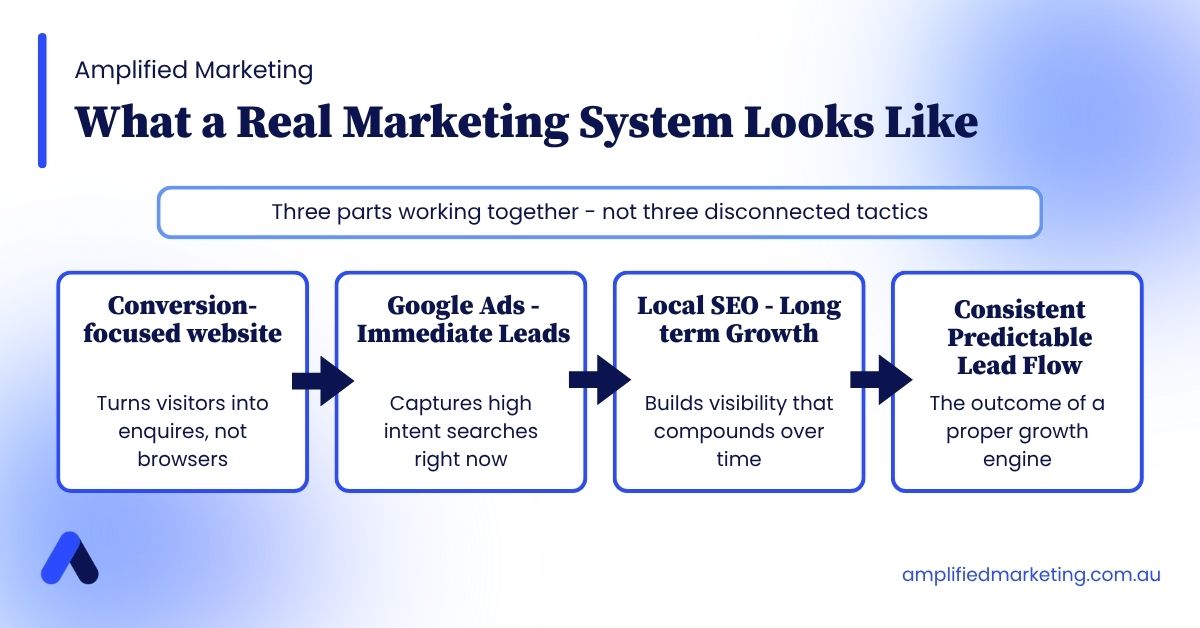
For most allied health practices, that system has three components working together:
A website built for conversion, not just information.
Your website isn’t a digital brochure — it’s the engine room of your entire marketing operation. It needs to speak directly to the problems your ideal clients are experiencing, build trust quickly, guide visitors towards taking action, and be properly set up to capture and track every enquiry. Most practice websites we encounter don’t do any of these things well — not because they were built badly, but because they were built by web designers, not marketers. Our work with SPOT Paediatrics is a good example of what changes when a website is rebuilt with conversion as the primary objective.
Google Ads for immediate, intent-driven leads.
When someone types “psychologist near me” or “physiotherapist Gold Coast” into Google, they’re actively looking for help right now. Google Ads puts you in front of that person at exactly the right moment — before they find a competitor and book there instead. Done properly, this is the fastest way to generate consistent new client enquiries, typically within the first few weeks of a campaign going live. Our Google Ads tips for allied health practices covers what good campaign management actually looks like.
Local SEO for long-term organic growth.
Google Maps visibility and organic search rankings are where the long-term wins compound. Building your local SEO presence takes longer than paid ads — typically three to six months before you start seeing meaningful results — but the leads it generates cost you nothing per click, and they grow over time. We’ve seen practices like Counselling in Melbourne nearly triple their website traffic through a focused local SEO strategy. Our guide to local SEO for allied health walks through the key foundations.
Together, these three elements create a pipeline that runs continuously — generating enquiries whether you’re in the clinic, at your desk, or on holidays.
What We’ve Seen Work in Practice
We’ve worked with psychology clinics, physio practices, OT clinics and podiatry practices across Australia, and the pattern when a proper system comes together is consistent.
Central Physio Bayswater increased new patient bookings by 65% over five months after we rebuilt their website for conversion and launched a targeted Google Ads campaign. Before that, they were relying heavily on GP referrals and walk-ins — solid, but not scalable.
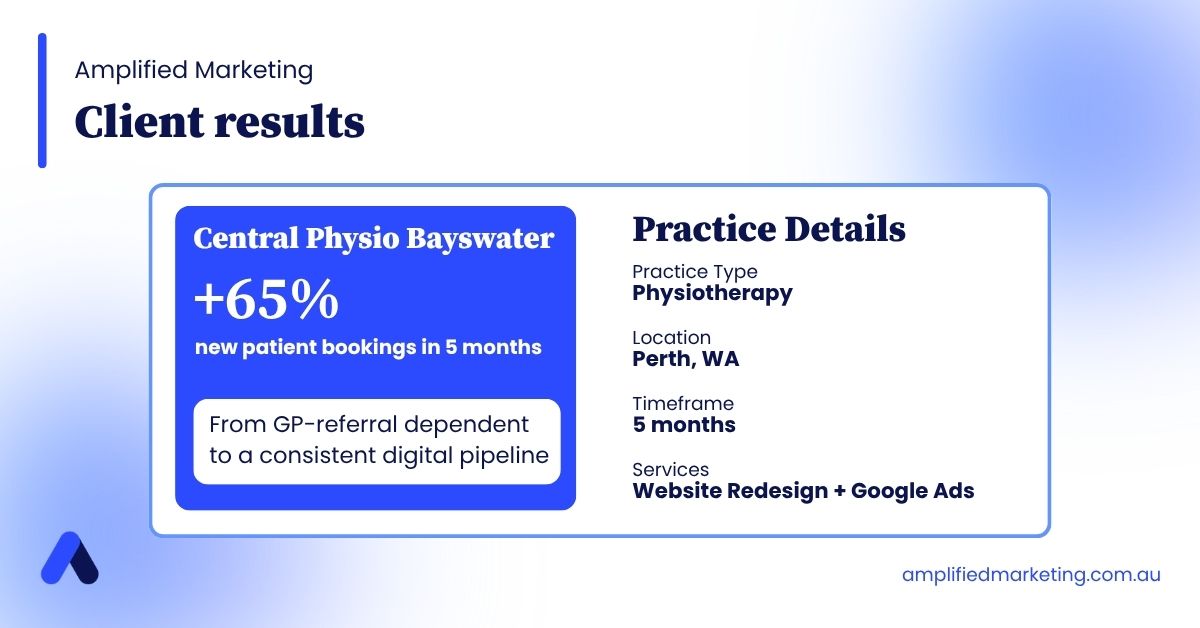
Queensland Osteopathic Clinic saw a 45% increase in client bookings within four months of launching a conversion-focused website and digital strategy — replacing a generic site that was generating almost no enquiries despite decent foot traffic.
The pattern is the same in both cases: a practice with strong clinical outcomes but an underperforming marketing presence, which once rebuilt, produced a meaningful step-change in enquiry volume and business growth.
The Peace of Mind You’re Actually After
The ROI of a good marketing system isn’t just measured in new clients. It’s measured in the mental load it removes.
When the system is working, you stop wondering whether this week’s social media post will somehow bring someone in. You stop checking your inbox hoping for a GP referral. You stop having the same anxious conversation about lead volume at every team meeting.
Instead, you have a pipeline. You have visibility. You have a number you can actually plan around — and confidence that next month will look after itself.
The most common thing we hear from practice owners once they’ve made this shift? “Why did I wait so long before doing this?”
If your practice has hit the ceiling — and you’ve recognised yourself anywhere in this article — the answer probably isn’t working harder or doing more of what got you here. It’s building the system that makes growth happen without you having to carry it all.
Ready to see what that could look like for your practice? Book a free Growth Diagnosis Call and we’ll put together a plan specific to where you’re at.