

If you run an allied health clinic in Australia and you’re not showing up in Google’s local map pack, you’re invisible to people actively searching for what you do — right now, in your suburb.
That’s not a small problem.
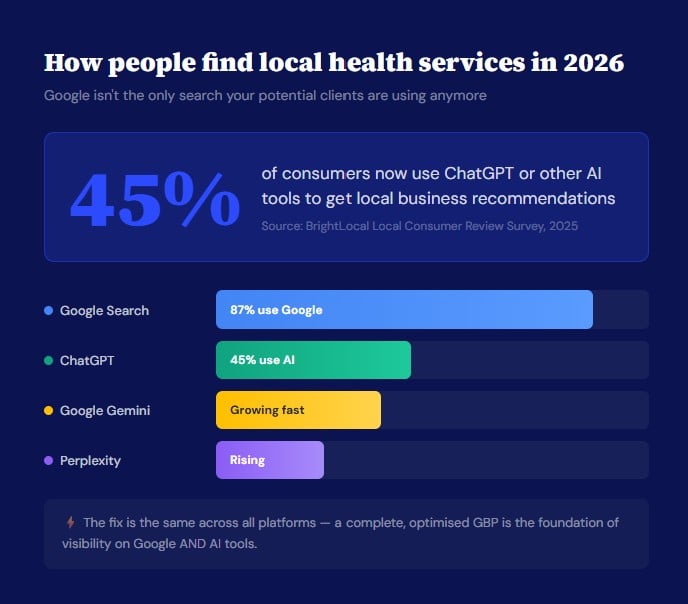
87% of consumers use Google to find local businesses. And 46% of all Google searches have local intent — someone in your postcode typing “psychologist near me” or “physiotherapy [suburb]” and either finding you or your competitor. For a clinic dependent on GP referrals and word of mouth, local search isn’t a nice-to-have. It’s the pipeline you’re not using. If that sounds familiar, it’s worth reading why so many allied health clinics hit a growth ceiling — local search visibility is one of the most common missing pieces.
Google Business Profile (GBP) is the free tool that determines what Google shows them. Get it right and you appear in the local map pack. Ignore it and those clients book elsewhere.
This guide walks you through exactly how to set it up, optimise it, and maintain it — with the AHPRA compliance guardrails your clinic actually needs.
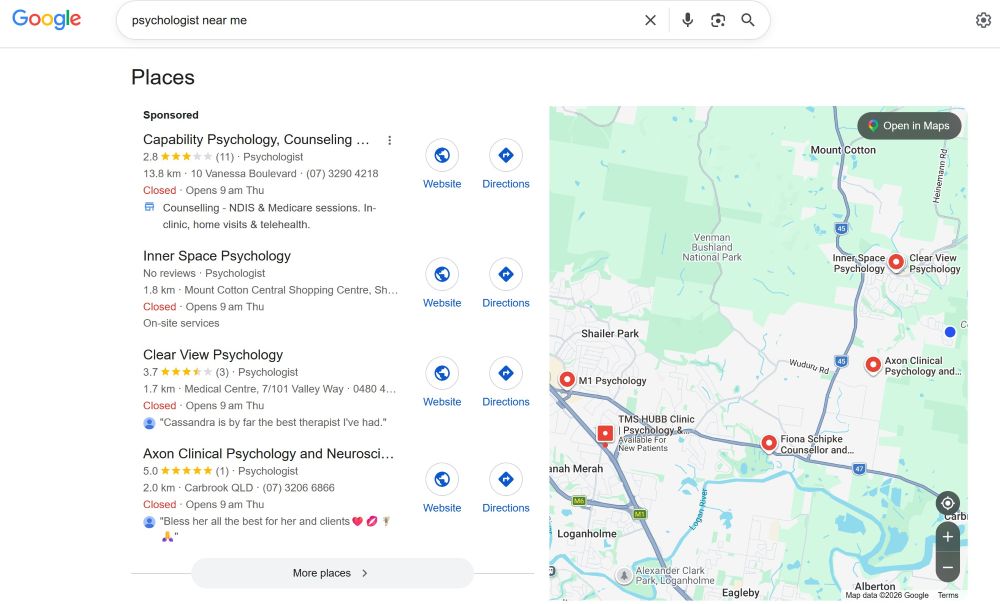
What is the local map pack and why does it matter?
When someone searches “occupational therapist Brisbane” or “speech pathologist near me”, Google often displays three businesses above the organic results. That’s the local map pack — the most valuable real estate in local search.
Businesses in the top three positions receive 93% more actions — calls, website clicks, direction requests — compared to those ranked 4–10. That’s not a marginal edge. That’s the gap between a full calendar and a half-empty one.
Your Google Business Profile is the foundation of map pack performance. Without an optimised GBP, you’re simply not in the race.
Step 1: Claim or create your profile
Before you create a new listing, search Google for your clinic name. Many established practices already have a profile — auto-generated from existing business data — sitting there unclaimed and incomplete.
If you find one, claim it. If there’s nothing there, head to business.google.com and create a new profile.
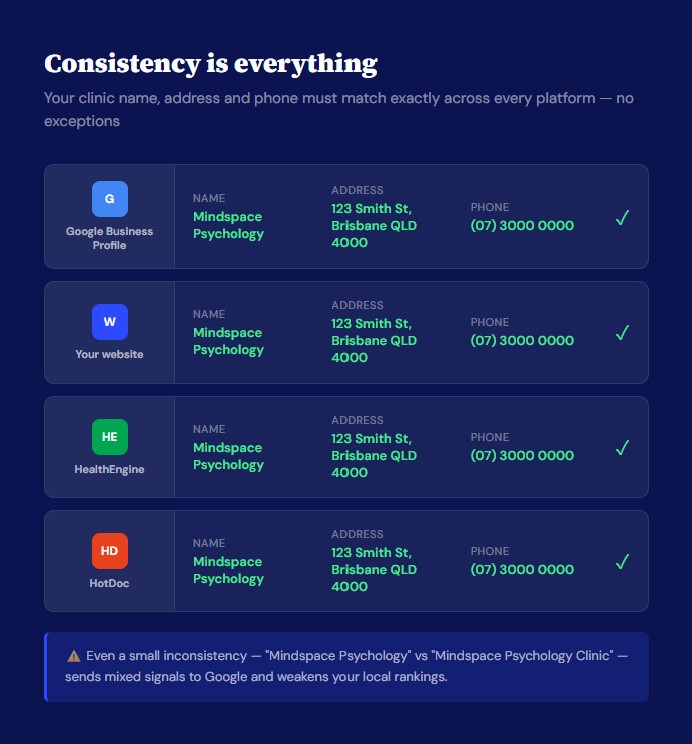
At this stage, the most important thing is consistency. Your business name, address, and phone number (NAP) need to match exactly across your website, HealthEngine, HotDoc, your Facebook page — everywhere. Inconsistency here sends mixed signals to Google and weakens your rankings.
Keep your business name clean. Don’t add your suburb or keywords to it (“Brisbane Anxiety Psychology Clinic” when your business name is “Mindspace Psychology”). Google treats this as keyword stuffing and it can backfire.
Step 2: Optimise your profile
Choose the right categories
This is the single highest-impact optimisation decision you’ll make — and the easiest to get wrong. According to Whitespark’s 2026 Local Search Ranking Factors report, choosing the wrong primary category is the number one negative ranking factor in local SEO.
Your primary category needs to match your core service:
- Psychologist or Psychology clinic
- Physiotherapist or Physical therapy clinic
- Occupational therapist
- Speech pathologist
- Mental health service
Add secondary categories where genuinely relevant. A psychology clinic might add “Counselling service” or “Mental health clinic”. A physio might add “Sports injury clinic” or “Rehabilitation centre”. Don’t pad it — only add what you actually provide.
Not sure who your ideal client is yet? This guide on building a patient avatar for allied health is a good starting point before you write your categories and description.
Write a description that does conversion work
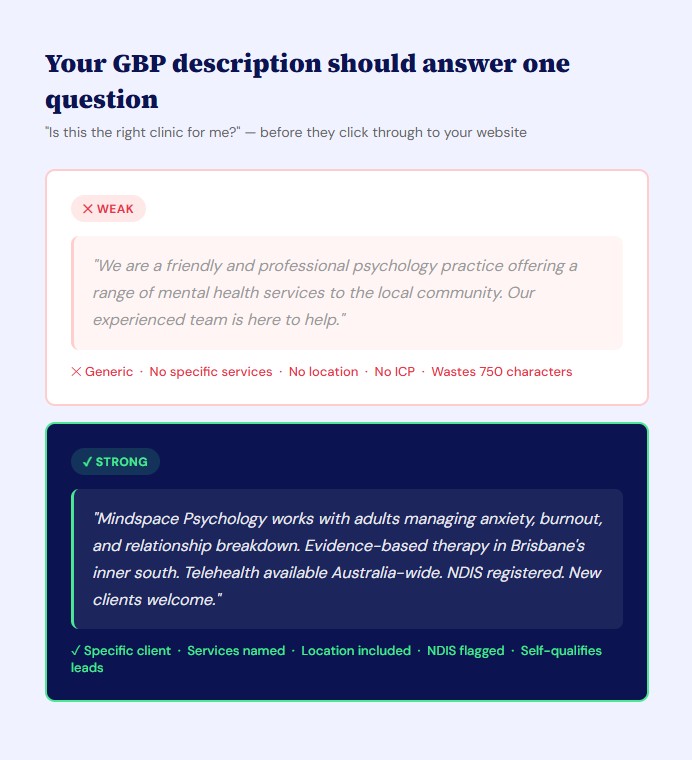
You have 750 characters. Use them to speak to the person searching, not to describe your business in abstract terms.
Profiles with keyword-rich, complete descriptions see 31% better local pack visibility. More importantly, a well-written description answers the question “is this the right clinic for me?” before someone even clicks. If you’re not sure how to write copy that speaks directly to your ideal client, this guide on client-focused website messaging covers the same principles.
Add your services in detail
List every service you offer individually. For a psychology clinic: individual therapy, couples counselling, EMDR, anxiety treatment, trauma therapy, NDIS psychological services, telehealth, assessments. For a physio: sports injury, post-surgical rehab, dry needling, hydrotherapy.
This gives Google more signals about what searches your profile should appear for — and helps potential clients self-qualify before they contact you.
Build a strong photo gallery
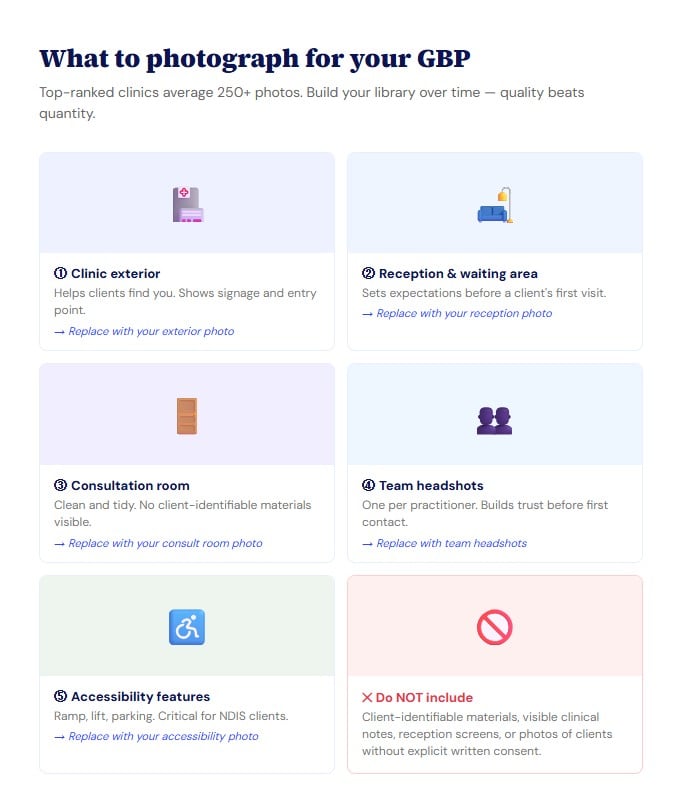
Profiles with quality photos receive 42% more direction requests and 31% more website clicks. And clinics appearing in the top three local positions average 250+ images on their GBP.
That doesn’t mean flooding your profile with low-quality shots. Build a library of authentic images over time:
- Clinic exterior (so clients can find you)
- Reception and waiting area
- Consultation rooms (no identifiable client materials)
- Team headshots
- Accessibility features — ramp access, lift, parking
One important note: any images featuring clients require proper consent, and you need to be careful about inadvertently disclosing someone’s attendance at your practice. Most clinics stick to environment and team photos — which is more than sufficient.
Step 3: Reviews — the AHPRA-compliant way
This is where most allied health clinics get nervous. And where most generic marketing advice fails them.
Here’s the reality: Google reviews are a significant ranking signal. Clinics with 50+ reviews and a 4.5-star-plus average are 57% more likely to rank in the top local results. 78% of people won’t consider a business rated below 4 stars. You need reviews — but you need to earn and handle them correctly.
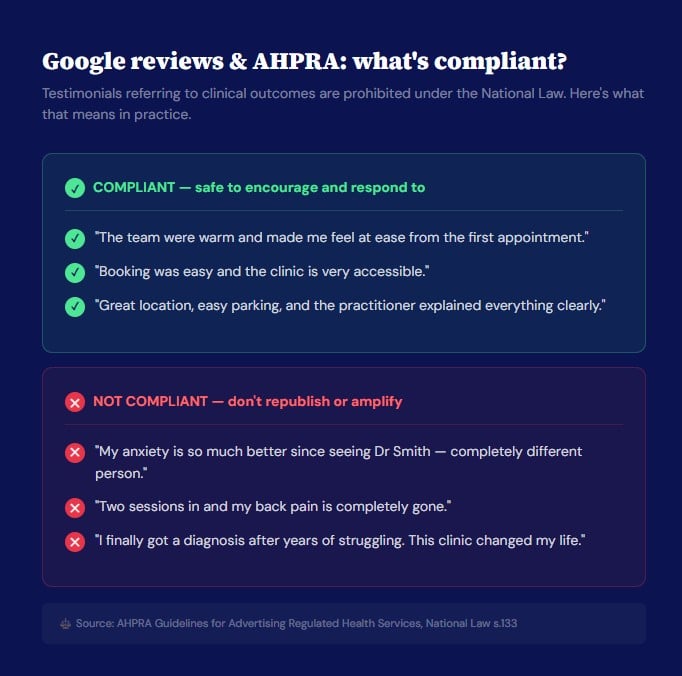
Under the National Law, testimonials referring to the clinical aspects of a regulated health service — symptoms, diagnosis, treatment, outcomes — are prohibited in advertising. So a review saying “My back pain is gone after two sessions” cannot be republished or amplified on your website or social channels without breaching AHPRA guidelines.
What’s permitted: reviews about a client’s experience — the professionalism of staff, ease of booking, accessibility, how supported they felt. These are fair game.
What this means in practice:
- Don’t republish or quote clinical outcome reviews on your website or social media
- Do encourage clients to leave reviews about their overall experience — without coaching the content
- Do respond to all reviews. Clinics that respond to reviews see 38% higher profile engagement. Keep responses professional, warm, and free of clinical detail.
When asking for a review, keep the request neutral: “If you’ve had a good experience with us, we’d really appreciate a Google review.” Don’t script it. Don’t suggest what to write.
Step 4: Google posts
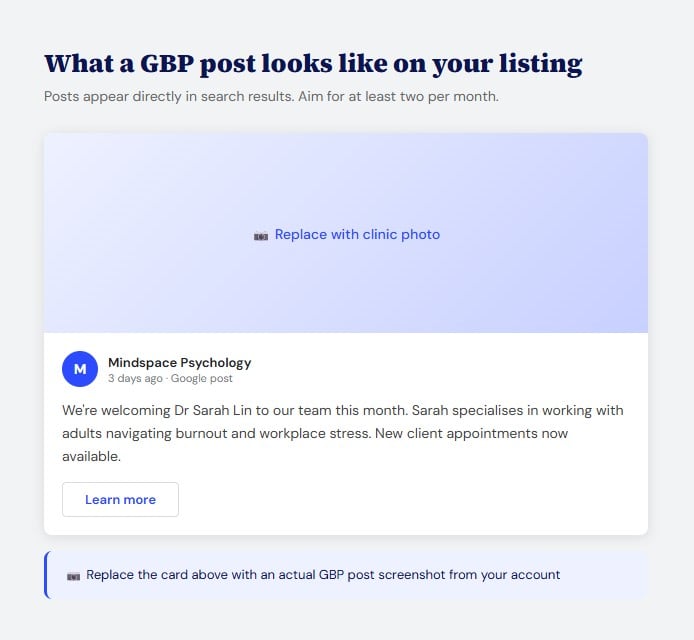
GBP posts are short updates that appear directly on your listing. Profiles with regular posts appear 2.8 times more frequently in top-three map results.
For an allied health clinic, post ideas include:
- New practitioners joining the team
- New or expanded services
- NDIS registration updates
- Mental Health Week or awareness campaign content
- Links to new blog content or resources
Keep every post AHPRA-compliant — no clinical outcome claims, no testimonials, nothing that creates unrealistic treatment expectations. Aim for at least two posts per month. Consistency matters more than volume — this article on marketing consistency for allied health clinics explains why showing up regularly beats sporadic bursts of activity every time.
Step 5: AI search is here — and your clinic needs to be ready
Here’s something that’s changed significantly in the last 12 months — and most clinics haven’t caught up yet.
People aren’t only using Google to find local services anymore. 45% of consumers now use ChatGPT or other AI tools for local business recommendations. Platforms like ChatGPT, Perplexity, and Google’s own Gemini are increasingly being asked questions like “what’s a good psychologist in [suburb]?” or “find me a physio in Brisbane who bulk bills.” That’s a significant and growing number of potential clients running a search that bypasses the traditional Google results page entirely.
Google has acknowledged this shift too. In late 2025, Google retired its long-standing Q&A feature on GBP and replaced it with an AI-powered “Ask Maps” tool driven by Gemini. Rather than static Q&A content, Google’s AI now generates real-time answers about your business by pulling from your GBP data, reviews, photos, and website. In other words: Google itself is now an AI answering questions about your clinic on your behalf. Better make sure it has accurate information to work with.
If you’re thinking about how AI fits into your broader content strategy, this article on using ChatGPT ethically for healthcare content is worth a read.
What AI tools actually look at
When an AI recommends a local business, it’s pulling from specific sources. ChatGPT surfaces business websites as its primary local source 58% of the time, followed by business mentions (27%) and online directories (15%). Perplexity and Gemini work similarly — drawing from your GBP data, your website content, your reviews, and your presence on reputable directories. SOCi’s 2026 Local Visibility Index, which analysed over 350,000 business locations, found that ChatGPT recommends just 1.2% of all local businesses — compared to the 35.9% of businesses that appear in Google’s local 3-pack.
In other words: the fundamentals of a well-optimised GBP are also the fundamentals of AI visibility.
Getting recommended in AI tools is roughly 30 times harder to achieve than ranking in Google’s local results. And fewer than half of businesses that appear in Google’s local pack also show up in AI recommendations. Most local businesses — including most allied health clinics — aren’t appearing in AI results at all.
AI tools tend to recommend businesses with an average rating of 4.3 stars or higher. Review quality matters here as much as it does in Google.
What to focus on
You can’t directly “optimise for ChatGPT” the way you optimise a Google ad. But you can make your clinic the kind of clearly-defined, well-documented, consistently-described business that AI tools are more likely to surface:
- A complete, keyword-rich GBP — AI tools reference your profile data directly
- A well-structured website with clear service pages and location information
- Consistent presence on reputable directories — HealthEngine, HotDoc, Healthdirect, Psychology Today (more on this below)
- A strong review profile with a rating above 4.3 stars
- Specific, clear language about who you work with — vague descriptions don’t help AI match your clinic to the right searches
The clinics building these foundations today are the ones who’ll show up in AI results tomorrow.
Step 6: Build consistent citations
A citation is any online mention of your clinic’s name, address, and phone number. Consistent citations across reputable directories strengthen Google’s confidence in your business data — and feed directly into the AI tools pulling from those same sources. Citations are one part of a broader local SEO picture — this article on local SEO for allied health clinics covers the full strategy if you want to go deeper.
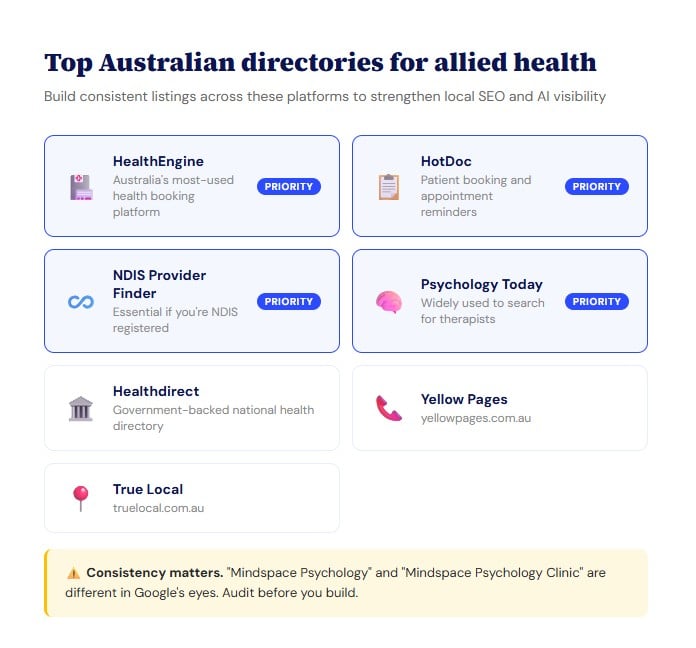
For allied health clinics in Australia, prioritise these:
- HealthEngine — Australia’s most widely used health booking platform
- HotDoc — major patient booking and reminder platform
- NDIS Provider Finder — non-negotiable if you’re NDIS registered
- Psychology Today — widely used by people searching for therapists
- Healthdirect — government-backed national health directory
- Yellow Pages (yellowpages.com.au)
- True Local (truelocal.com.au)
The key is consistency. If your clinic is “Mindspace Psychology” on GBP but “Mindspace Psychology Clinic” on HealthEngine, that discrepancy matters. Audit your existing listings before building new ones.
Step 7: Track your performance
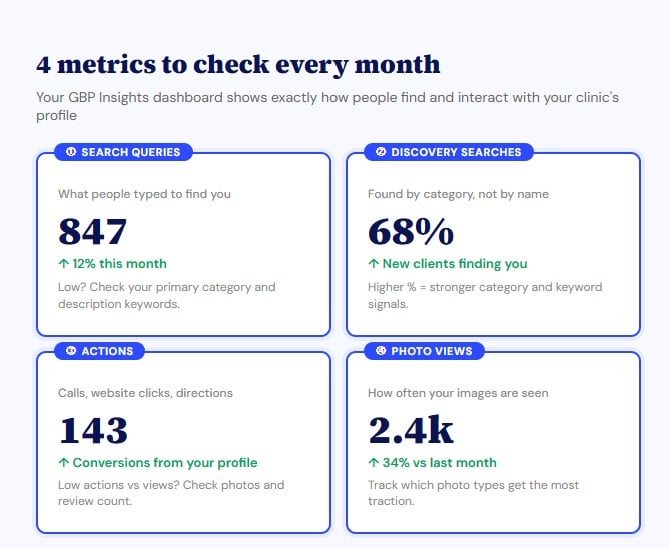
GBP has a built-in insights dashboard showing how people find and interact with your profile. Check it monthly. If you want a broader view of where your clinic’s digital presence stands before diving into the data, the allied health practice digital readiness checklist is a useful starting point.
Key metrics to watch:
- Search queries — what are people typing to find you?
- Discovery vs direct searches — are people searching your name, or finding you through category/service searches?
- Actions — calls, website clicks, direction requests
- Photo views — which images are getting engagement?
Low discovery searches usually point to a category or keyword signal issue. Good view numbers with low actions usually means a conversion problem — your photos, description, or review count need work.
GBP is the floor, not the ceiling
An optimised Google Business Profile gets you visible. It’s where local marketing starts — and for many allied health clinics, it’s one of the fastest and cheapest wins available.
But it’s one piece of a larger system. GBP works best when it’s supported by a well-structured website, consistent local SEO, and a clear picture of who your ideal clients are. Without that, you’re optimising a profile that points to a leaky bucket. If you’ve spent money on marketing before without seeing results, this article on why allied health marketing budgets get wasted is worth your time. And if you’re thinking about what sustainable, long-term growth actually looks like, this piece on playing the long game in allied health marketing covers the bigger picture.
If you’d like a clear read on where your clinic’s online presence stands — and what would actually move the needle — a Clinic Growth Diagnostic is a good place to start. It’s a free strategy call, no pitch, just clarity.