AI can now manage every part of your Google Business Profile… Except the part that matters most

In June 2026, Google announced that Gemini, its AI assistant, will connect directly to Google Business Profiles. The rollout is global — Australia included — with only the EEA and UK excluded, and it’s being released gradually, so if you don’t see it in your Gemini app yet, you will. Once connected, the integration lets any business owner ask Gemini to update their opening hours, post seasonal updates, analyse their profile performance, find gaps in their listing, and even draft replies to their Google reviews.
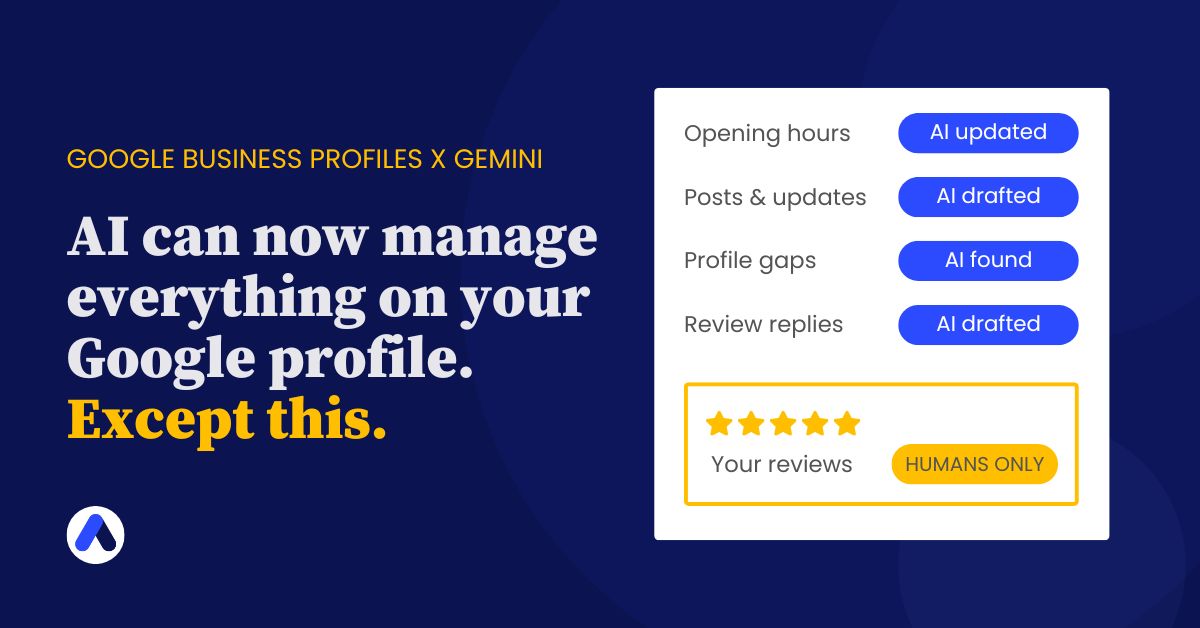
Read that list again. For years, “optimise your Google Business Profile” has been a service line — something practices either paid an agency to do, fumbled through themselves, or ignored entirely. Now Google is handing every business owner an assistant that does the baseline work in a chat window.
So what happens when everyone’s profile is optimised?
The floor is rising
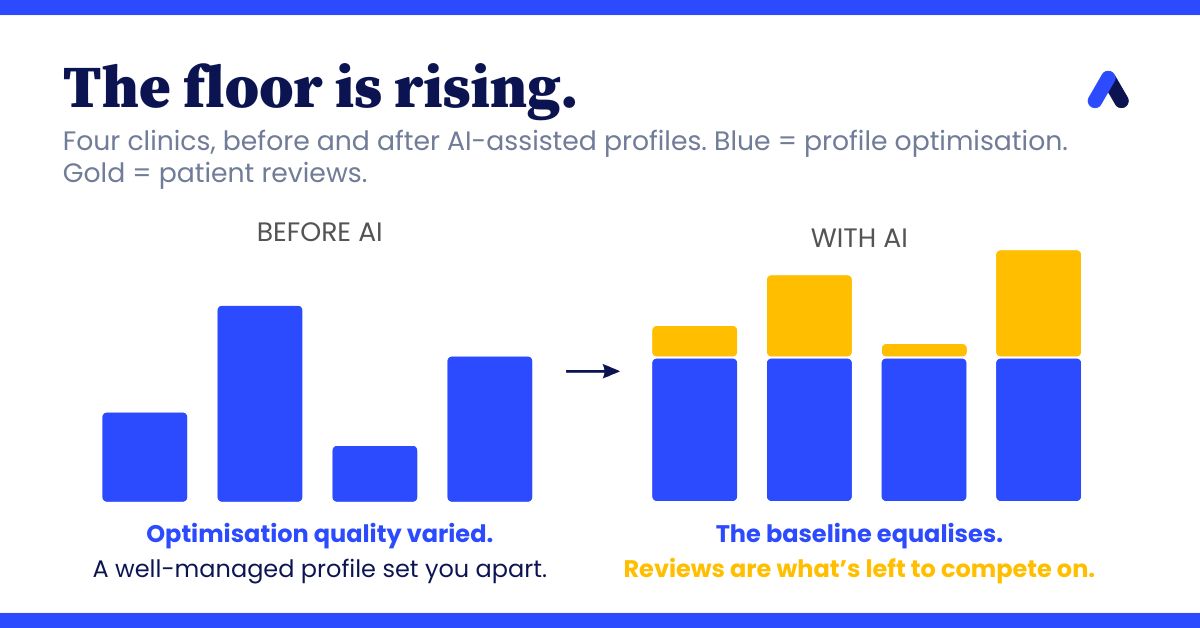
Let’s be clear about what this announcement does and doesn’t mean. It doesn’t mean every allied health practice in Australia will suddenly have a perfect profile. Most practice owners won’t connect Gemini for months, if ever. Plenty will connect it and never act on a single suggestion. The gap between practices that take local visibility seriously and those that don’t will still exist.
But the floor is rising. The basic hygiene tasks — complete information, current hours, regular posts, answered questions, replied-to reviews — are getting cheaper and easier for everyone. Over the next year or two, “my profile is properly filled out” stops being a competitive advantage and becomes table stakes, the same way “we have a website” did fifteen years ago.
And when everything you control gets easier to optimise, the competitive weight shifts to the things you can’t control.
The one thing AI can’t write
Here’s the irony buried in Google’s announcement: Gemini can now draft your reply to a review. It cannot write the review.
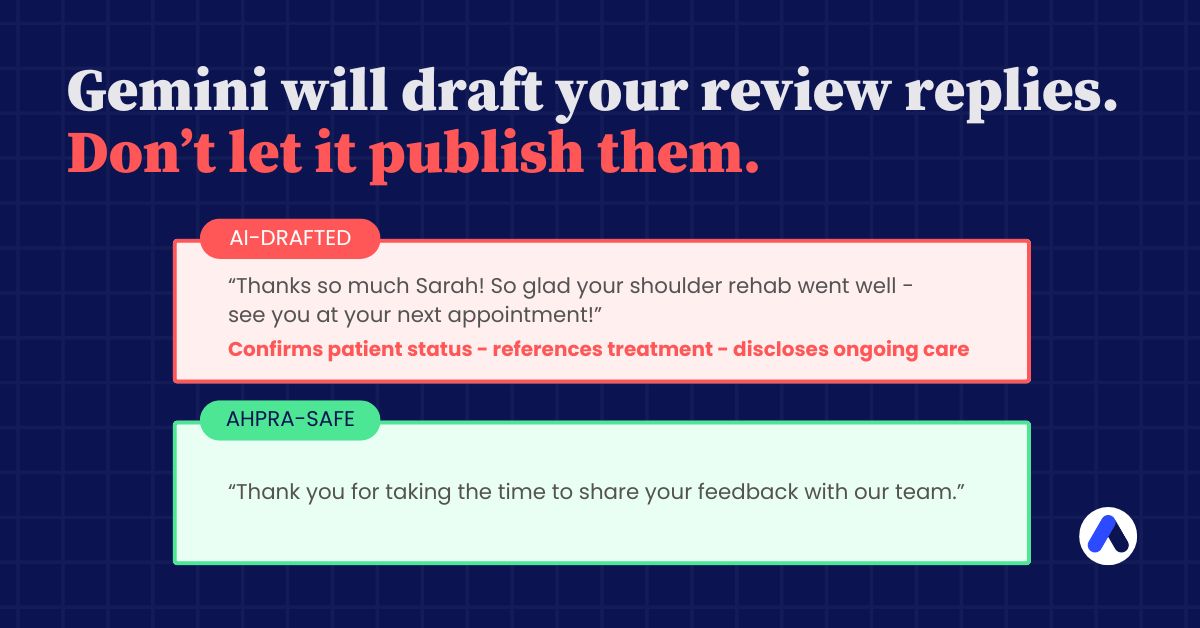
And for allied health, that first part deserves a warning label of its own. Gemini doesn’t know AHPRA exists. An AI-drafted reply that warmly references someone’s treatment, confirms they’re a patient, or amplifies praise about clinical outcomes can create a compliance and privacy problem in a single friendly sentence — AHPRA’s own guidance notes that even engaging with reviews can cross into using a testimonial. More on that below, because it’s exactly why practices need a human system around this tool, not just the tool.
The review itself, though — the volume of them, how recent they are, what real patients actually say about their experience at your clinic — is the one asset on your entire Google presence that can’t be generated, automated, or bought. (And before anyone gets ideas: Google is already using Gemini on the other side of this equation, to detect and remove fake reviews and suspicious profile edits. The authenticity bar is going up, not down.)
This is what makes reviews more valuable in an AI-optimised world, not less. When every podiatry clinic in your suburb has a complete, well-maintained, AI-assisted profile, the question a potential patient — or Google’s algorithm — has to answer is: what’s actually different about these clinics? And the most honest data available is what patients say.
Reviews aren’t just a ranking factor anymore — they’re AI’s source material
There’s a second shift happening that makes this even more important, and almost nobody is talking about it in allied health.
It’s not just that reviews help you rank in the map pack (they do, and they always have). It’s that AI tools are increasingly the thing making the recommendation — and reviews are the raw material they use to make it.
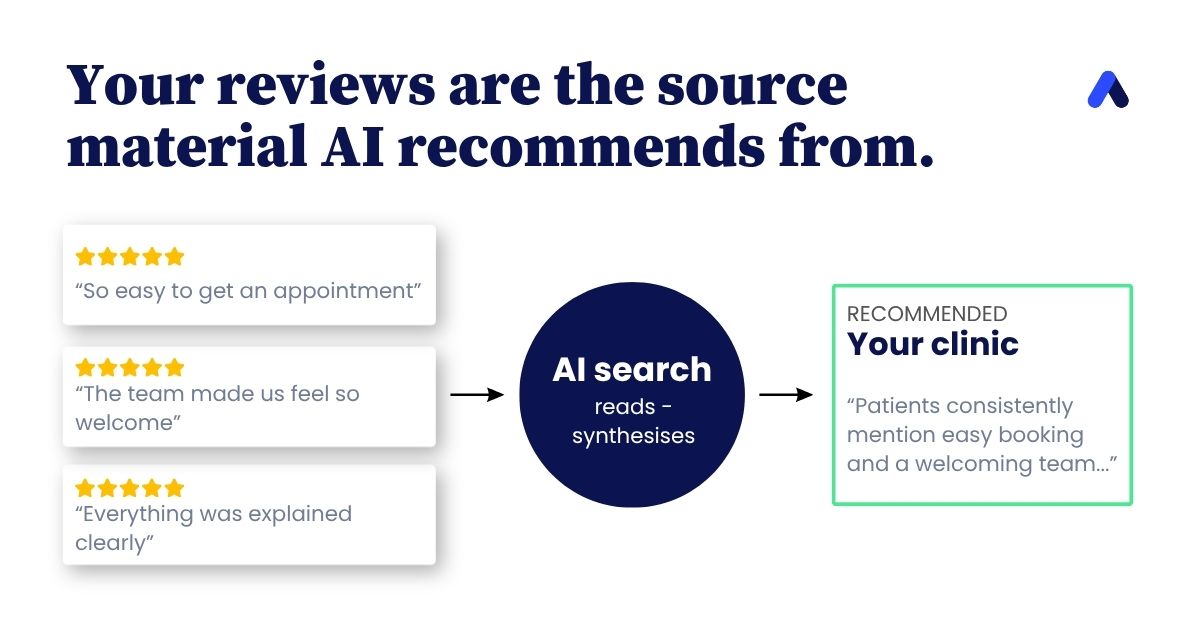
When someone asks Gemini, ChatGPT, or Google’s AI Mode “best paediatric speech pathologist near me” or “physio near Carindale that’s easy to get into,” the AI isn’t just counting stars. It’s reading and synthesising review content: what patients mention, what they praise, how recently, how consistently. And to be crystal clear — this doesn’t mean you want reviews describing treatments or outcomes (we’ll get to why in a moment). It means the experience details matter: how easy the clinic was to book, how welcome someone felt, how well things were explained, the suburb, the parking, the front desk. A clinic with 80 recent reviews rich in that kind of everyday detail gives an AI model plenty of material to recommend from. A clinic with 9 reviews that say “great service” gives it almost nothing.
In other words: your reviews used to influence where you appeared in a list. Increasingly, they determine whether you’re recommended at all.
“But we’re not allowed to use reviews” — the AHPRA reality
This is where most allied health practice owners stop. Somewhere along the line, “AHPRA has rules about testimonials” became “we can’t do anything with reviews,” and so many genuinely excellent clinics sit on a handful of reviews while their reputation lives entirely offline.
That caution is understandable — but the blanket version of it is wrong, and it’s costing practices visibility. Here’s the practical reality:
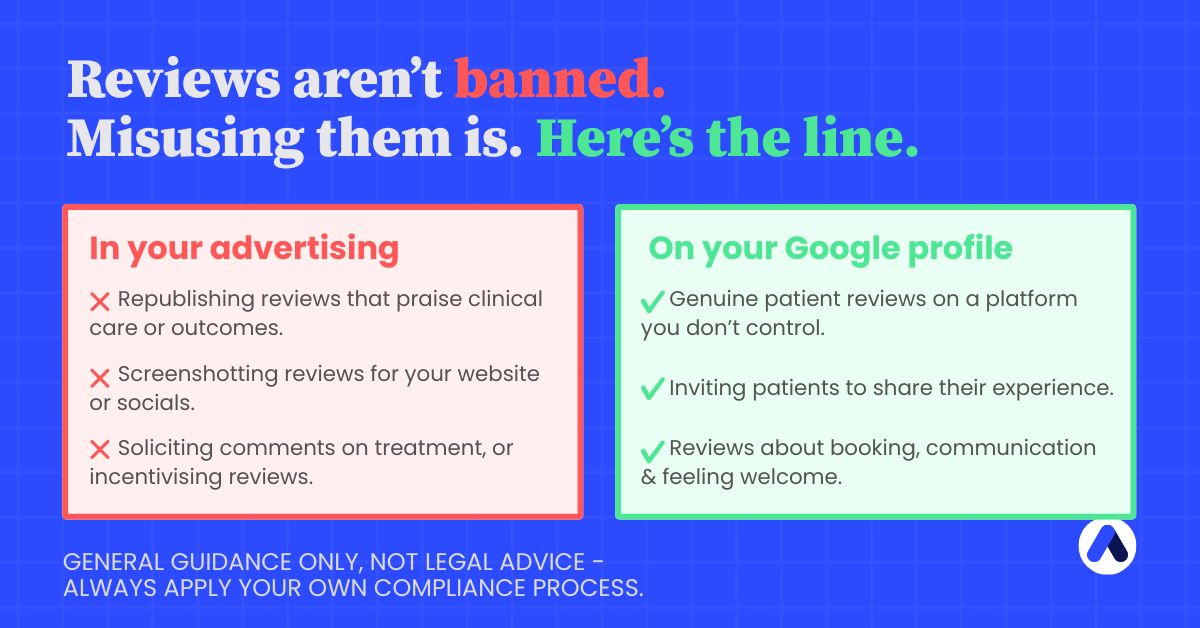
Patients leaving reviews on Google is not the problem. Genuine, unsolicited reviews that patients leave on a platform you don’t control are not your advertising. You’re not breaching anything by having a profile full of positive reviews.
What you do with reviews is where the rules bite. The National Law restricts using testimonials about clinical care in your advertising — and AHPRA’s advertising guidelines are explicit that a “testimonial” means a positive statement about the clinical aspects of a health service used in advertising. Comments about customer service or communication style, by AHPRA’s own definition, are not testimonials. In practice, that means: don’t copy reviews praising treatment outcomes onto your website, your socials, or your brochures. Don’t cherry-pick and republish “they fixed my back pain” anywhere you control.
You can ask for reviews — ask the right way. Inviting patients to share feedback about their experience is fine. What you shouldn’t do is solicit comments on clinical care or outcomes, offer incentives, or script what patients should say. A simple, neutral ask — “if you’d like to share your experience with our clinic, you can leave a review here” — sent at the right moment, is both compliant and effective. (As always: this is general guidance, not legal advice, and your own compliance processes should have the final say.)
Reply carefully — especially now that AI is drafting for you. Responding to reviews is good practice, and Gemini will happily draft those replies. But AHPRA’s guidance specifically flags that engaging with reviews on third-party sites can itself amount to using a testimonial — for example, a reply that repeats or endorses praise about clinical care. And beyond the testimonial rules, a reply must never confirm the reviewer is a patient, reference their treatment, or discuss health information. “Thank you for taking the time to share your feedback” works. “Glad your shoulder rehab went well, Sarah” is a privacy breach wearing a friendly hat — and it’s exactly the kind of thing an AI that doesn’t know AHPRA will cheerfully draft. Human review before publishing isn’t optional in this industry; it’s the whole job.
The practices that win here won’t be the ones that ignore AHPRA or the ones paralysed by it. They’ll be the ones that understand exactly where the line is and build a steady, compliant review engine right up to it.
What to actually do this quarter
If you accept the argument — AI raises the floor on everything you control, so the differentiator becomes what your patients say — then the to-do list is refreshingly simple:
- Make the ask systematic, not occasional. One review request blitz gives you a suspicious spike. A consistent ask, built into your client journey at the moment of genuine satisfaction, gives you the steady recency and volume that both humans and AI trust.
- Aim for specificity, not just stars — the compliant kind. Reviews that mention your suburb, the ease of getting an appointment, how welcome someone felt, how clearly things were explained — that’s the material AI recommendations are built from, and none of it touches clinical territory. You can’t script it (and shouldn’t), but you can time your asks for the patients most likely to write something real.
- Reply to everything, compliantly. Every reply signals an attentive, operating business — to patients and to algorithms. Use AI to draft if you like; never let it publish unread.
- Stop letting the testimonial rules cost you the review game. Audit what you’re currently doing (or not doing) and fix the actual compliance risks — republished clinical testimonials, incentivised asks — rather than avoiding reviews altogether.
The businesses that treated their Google profile as a set-and-forget listing are about to get a free AI assistant that papers over their neglect. The practices that pull ahead will be the ones holding the asset AI can’t fake: a deep, recent, authentic record of what it’s actually like to be their patient.
That’s not something you can optimise in a chat window. It’s something you earn, one patient at a time — with a system behind it.
Amplified Marketing helps allied health practices across Australia get found by the right clients — with AHPRA compliance built into everything we do. If you’re not sure how your clinic’s visibility stacks up in an AI-first search world, book a chat with us and we’ll show you exactly where you stand.